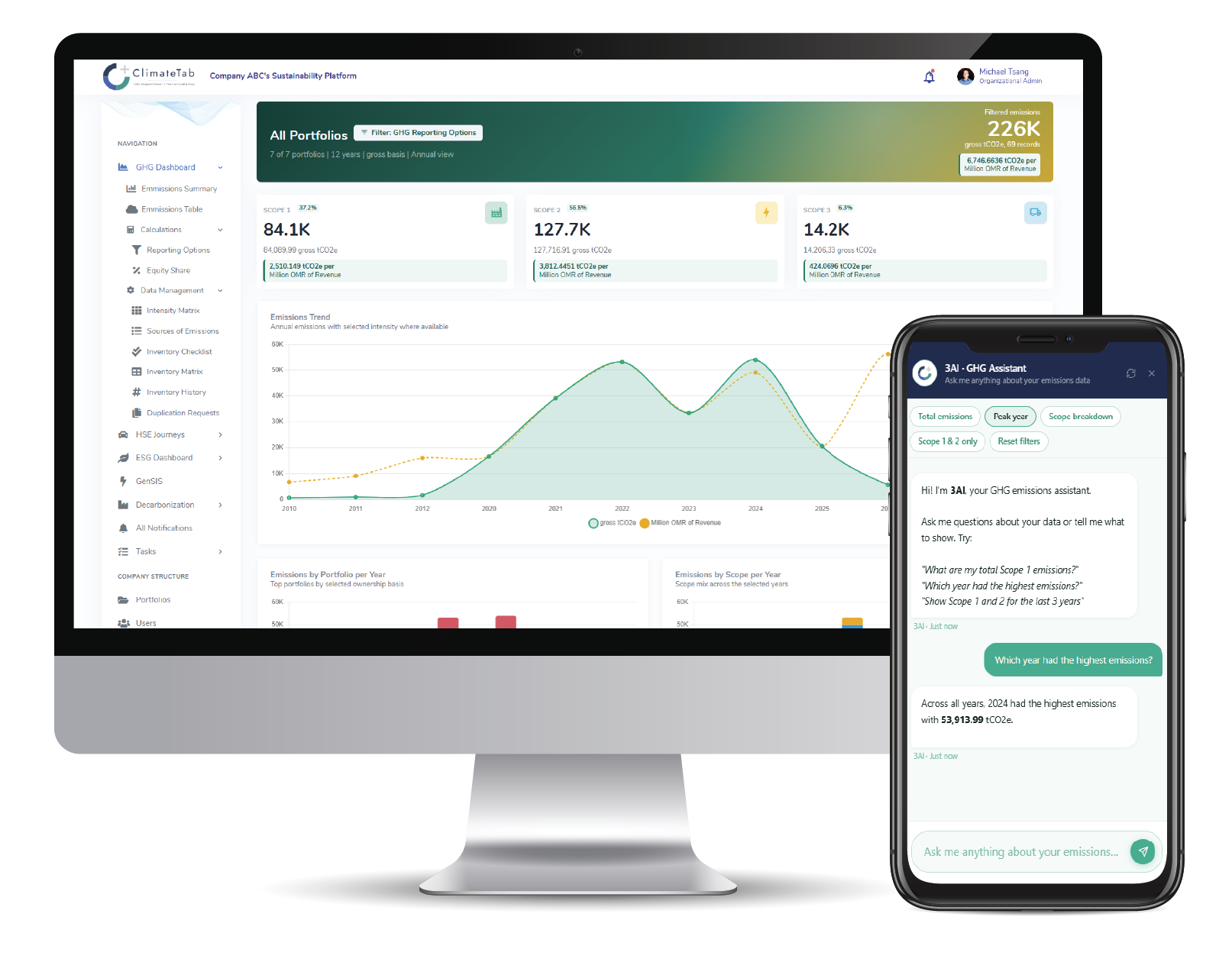
In today’s evolving regulatory landscape, businesses across Oman, the GCC, and globally are increasingly recognizing the importance of not just measuring current emissions, but also anticipating future trends. Emissions forecasting is a strategic imperative, providing a roadmap for decarbonization efforts and informing long-term business planning.
Effective forecasting allows organizations to set ambitious yet achievable targets, allocate resources wisely, and proactively adapt to new climate policies and market demands. It moves sustainability from a compliance exercise to a core component of business strategy.
Why Forecast Emissions?
Forecasting emissions offers several key benefits:
- Strategic Planning and Target Setting: To set science-based targets or align with national decarbonization goals, businesses need a clear projection of their emissions trajectory under various scenarios. This enables the establishment of realistic and impactful reduction goals.
- Risk Management: Anticipating future emissions helps identify potential risks associated with carbon pricing, regulatory changes, and reputational damage. It allows companies to develop mitigation strategies proactively.
- Investment Decisions: Forecasts can guide investment in low-carbon technologies, energy efficiency projects, and sustainable supply chain initiatives, ensuring capital is directed towards projects with the greatest impact on emissions reduction.
- Stakeholder Communication: Transparent forecasting demonstrates a commitment to sustainability to investors, customers, and regulators, enhancing corporate reputation and fostering trust.
- Compliance Preparedness: As reporting requirements become more stringent, understanding future emissions helps organizations prepare for upcoming disclosures and avoid penalties.
Key Elements of Emissions Forecasting
A robust emissions forecasting process typically involves several critical steps:
- Baseline Establishment: Begin with an accurate and comprehensive baseline of historical GHG emissions, covering Scope 1, Scope 2 (both location- and market-based), and Scope 3 emissions, following frameworks like the GHG Protocol. This baseline serves as the foundation for future projections. ClimateTab supports comprehensive corporate GHG inventories, ensuring all scopes and consolidation approaches (operational control, financial control, equity share) are accurately accounted for.
- Activity Data Projections: Forecast future business activity levels that drive emissions. This includes projections for production volumes, fleet mileage, energy consumption, and supply chain activities. Economic growth projections, market demand, and business expansion plans are all relevant inputs.
- Emissions Factors: Apply appropriate emissions factors to projected activity data. These factors may change over time due to grid decarbonization, fuel switching, or technological advancements.
- Scenario Planning: Develop multiple scenarios to account for uncertainties. These might include a 'business-as-usual' scenario, an 'ambitious decarbonization' scenario, and scenarios reflecting different regulatory environments or technology adoption rates.
- Mitigation Project Integration: Incorporate the impact of planned and potential decarbonization projects. This involves quantifying the emissions reductions expected from initiatives such as renewable energy adoption, fleet electrification, process improvements, or supply chain engagement. ClimateTab's Decarbonization Manager is built to help organizations define targets, track progress against forecasts, and manage mitigation projects effectively.
- Regular Review and Adjustment: Emissions forecasts are not static. They require regular review and adjustment based on actual performance, changes in business operations, and updates to external factors like regulations or technology availability.
Techniques for Forecasting
Several techniques can be employed for emissions forecasting:
- Trend Analysis: Extrapolating historical emissions trends into the future, assuming past patterns will continue. This is often a starting point but may not capture significant changes.
- Regression Analysis: Identifying statistical relationships between emissions and key business drivers (e.g., production output, revenue). This allows for more dynamic forecasting based on projected driver changes.
- Process-Based Modeling: Building models that simulate specific operational processes and their associated emissions, allowing for detailed analysis of the impact of technological changes or efficiency improvements.
- Expert Judgment: Incorporating insights from subject matter experts to refine forecasts, particularly for areas with high uncertainty or emerging technologies.
By integrating these elements and techniques, businesses can develop robust emissions forecasts that support informed decision-making and drive meaningful progress toward sustainability goals. Tools like ClimateTab provide the necessary infrastructure for collecting and managing the underlying data, facilitating scenario analysis, and tracking the impact of decarbonization projects, making the forecasting process more efficient and reliable.
Understanding your future emissions trajectory is not just about compliance; it's about building a resilient, sustainable business for the long term. Schedule a demo today to see how ClimateTab can support your emissions forecasting and decarbonization journey.

